
Industrial IoT Sensor Node with Infineon DPS310 and TLI4966G
Industrial AutomationA complete industrial IoT sensor node solution combining the Infineon DPS310 barometric pressure and temperature sensor with the TLI4966G dual Hall-effect speed sensor, sourced from BeiLuo. This solution enables real-time environmental monitoring, rotating machine health tracking, and predictive maintenance in Industry 4.0 factory automation deployments.
Key Advantages
- Infineon DPS310 provides barometric pressure accuracy of plus or minus 0.06 hPa and temperature accuracy of plus or minus 0.5 degrees C in a 2 x 2 x 1 mm LGA package for space-constrained industrial nodes
- TLI4966G dual differential Hall-effect sensor detects gear tooth speed with air gaps up to 3 mm, enabling non-contact speed measurement on rotating shafts without encoder coupling
- Both sensors operate from a 1.7 to 3.6 V supply, compatible with ultra-low-power MCU platforms for battery-backed wireless sensing over multi-year deployment cycles
- BeiLuo stocks DPS310 and TLI4966G in volume, providing stable supply for factory-scale IIoT deployments requiring hundreds or thousands of sensor nodes
Overview of Industrial IoT Sensor Node Design
Industrial IoT (IIoT) sensor nodes are the data-collection foundation of smart factory and predictive maintenance programs. A well-designed sensor node integrates environmental and mechanical sensing capability, low-power processing, and wireless communication in a package ruggedized for continuous industrial operation. Infineon's DPS310 precision pressure and temperature sensor and TLI4966G dual differential Hall-effect speed sensor are purpose-built for these demanding applications, combining high measurement accuracy with wide operating temperature ranges and resistance to mechanical shock and vibration. BeiLuo stocks both components and provides FAE support for node PCB layout, firmware development, and wireless protocol selection.
DPS310 Pressure and Temperature Sensing
The Infineon DPS310 is a miniature barometric pressure and temperature sensor packaged in a 2.0 x 2.0 x 1.0 mm LGA (land grid array) outline. Its piezoresistive pressure sensing element achieves absolute pressure accuracy of plus or minus 1 hPa and relative pressure accuracy of plus or minus 0.06 hPa over the 300 to 1200 hPa operating range -- equivalent to altitude discrimination of approximately 50 centimeters, far exceeding the requirements of industrial pressure monitoring. The integrated temperature sensor achieves plus or minus 0.5 degrees C accuracy from -40 to +85 degrees C, covering the full extended industrial temperature range.
The DPS310 communicates via I2C (up to 3.4 MHz) or SPI (up to 10 MHz), with two selectable I2C addresses enabling two devices per bus segment. An internal FIFO with 32 measurement entries allows the MCU to remain in deep sleep for extended intervals, collecting pressure and temperature data in the background at programmable oversampling rates from 1 to 128. At single oversampling with a 1 Hz measurement rate, the DPS310 consumes only 1.7 microamp of average current, making it ideal for battery-powered nodes with multi-year deployment targets.
On the PCB, the DPS310 must have a pressure port -- a small hole or vent -- to expose the sensing element to the ambient atmosphere. A hydrophobic breathable membrane over this vent prevents water ingress while allowing pressure equalization. This assembly, combined with an IP67 enclosure, enables DPS310 nodes to survive industrial wash-down cycles and outdoor weather exposure without affecting measurement accuracy.
TLI4966G Speed and Direction Detection
The Infineon TLI4966G is a dual differential Hall-effect sensor designed for non-contact detection of ferromagnetic gear tooth passing speed and rotational direction on motor shafts, conveyor rollers, and pump impellers. The device houses two Hall sensor cells spaced 3.0 mm apart in a flat package compatible with reflow soldering. This differential channel architecture enables XOR-based direction detection: when a north magnetic pole passes sensor A before sensor B, the direction output signals clockwise rotation; reversed order indicates counterclockwise. The direction information is latched at each speed pulse edge, providing reliable direction data even at slow crawling speeds below 1 RPM.
The TLI4966G operates with air gaps between the sensor face and the gear tooth surface up to 3 mm, eliminating the need for precise mechanical alignment during installation. Its output is a push-pull digital signal compatible with 1.7 to 5.5 V logic levels, directly connectible to MCU GPIO pins without level-shifting. The device is rated for operation from -40 degrees C to +150 degrees C, making it suitable for proximity to motor housings or gearboxes that run hot. Electromagnetic immunity to the high radiated fields found near motor inverters is achieved through internal signal filtering and digital blanking, producing clean digital speed pulses even in electrically noisy factory environments.
MCU Integration and Firmware Architecture
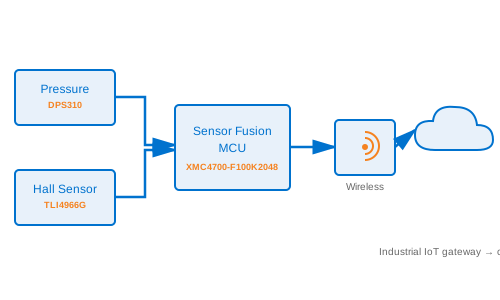
The DPS310 and TLI4966G connect to a low-power MCU such as the Infineon XMC1000 or a Nordic nRF52 for BLE applications. The I2C bus from the DPS310 runs at 400 kHz standard mode, with the MCU polling the DPS310 FIFO at 10-second intervals in normal operation and switching to 1-second intervals when pressure trend analysis indicates an alarm condition. TLI4966G pulses are counted by a timer-capture peripheral, with the MCU calculating shaft RPM from inter-pulse intervals in microseconds. An RTOS (real-time operating system) task scheduler with tickless idle mode keeps the MCU in deep sleep between sensing events, achieving average system current below 50 microamps for a 12-month battery life on a 1000 mAh lithium primary cell.
Wireless Communication
Sensor data is transmitted over BLE 5.0 for short-range applications (up to 100 m line of sight to a BLE gateway) or LoRa 868 MHz for long-range low-power wide-area network (LPWAN) coverage across large factory floors. A JSON payload of 50 to 100 bytes per transmission, sent every 30 seconds, conveys current pressure, temperature, shaft RPM, and alarm flags to the edge gateway. At the gateway, a lightweight edge analytics engine applies CUSUM (cumulative sum) change-point detection to the pressure and speed time series, generating alerts when drift exceeds predefined thresholds. Alerts are forwarded via MQTT to a cloud dashboard for maintenance team review.
Environmental Hardening and Deployment
The sensor node PCB is potted or enclosed in an IP67-rated polycarbonate or aluminum housing. Conformal coating on the PCB surface protects against condensation and corrosive gases present in food processing and chemical plant environments. The TLI4966G is mechanically secured with a stainless steel bracket that maintains a fixed air gap to the target gear over the thermal expansion range of the motor bearing housing from -20 to +100 degrees C.
Application Scenarios and BeiLuo Supply
DPS310 and TLI4966G sensor nodes from BeiLuo address predictive maintenance in compressed air systems, conveyor drives, pump stations, HVAC air handlers, and multi-axis robot gearboxes. Factories deploying hundreds of nodes benefit from BeiLuo's volume stock, tape-and-reel packaging, and consistent lot traceability. Our FAE team reviews node PCB designs, evaluates I2C bus signal integrity, and advises on FIFO configuration to optimize power consumption for each specific deployment scenario.
Bill of Materials
| Part No. | Description | Qty |
|---|---|---|
| DPS310 | High-precision barometric pressure and temperature sensor with I2C/SPI interface in 2 x 2 mm LGA package | 1 |
| TLI4966G | Dual differential Hall-effect speed sensor for non-contact rotational speed and direction detection in harsh industrial environments | 1 |
| XMC4700-F100K2048 | 144 MHz ARM Cortex-M4F MCU with I2C/SPI and Ethernet MAC -- sensor data aggregation and gateway edge processing | 1 |
Ready to Build This Solution?
Contact BeiLuo for component sourcing, FAE support, and reference designs.
Get BOM Quote