
Embedded Control Solution with Infineon AURIX TC264DA and XMC4700 MCU
Embedded ControlA scalable embedded control solution featuring the Infineon AURIX TC264DA dual-core TriCore MCU for automotive safety applications and the XMC4700 ARM Cortex-M4F MCU for precision industrial motor control, both stocked at BeiLuo. This solution covers functional safety, real-time control firmware, communication interfaces, and development toolchain integration.
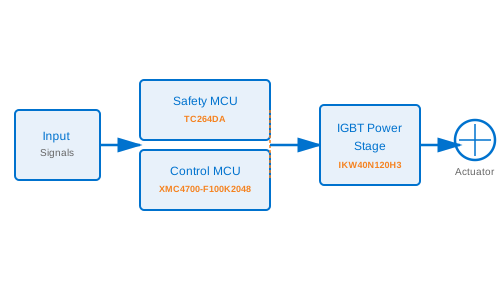
Key Advantages
- TC264DA dual TriCore 1.6P cores at 200 MHz with hardware lockstep and on-chip HSM enable ASIL-D certification without external safety supervisors, reducing BOM cost and PCB area
- XMC4700 ARM Cortex-M4F at 144 MHz with CCU8 capture-compare unit generates six complementary PWM signals for three-phase motor control with 10 ns resolution and hardware dead-time insertion
- Both MCUs are qualified to AEC-Q100 automotive-grade standards, supporting -40 to +125 degrees C operation in powertrain, chassis, and body control applications
- BeiLuo maintains in-stock inventory of TC264DA and XMC4700-F100K2048 with full traceability and offers MCAL startup code and evaluation board support to accelerate customer designs
Overview of Embedded Control with Infineon MCUs
Embedded control systems are the computational backbone of modern automotive electronic control units (ECUs) and industrial programmable logic controllers (PLCs). The requirements for these controllers have escalated in the past decade: automotive ECUs must satisfy ISO 26262 functional safety standards up to ASIL-D, while industrial servo drives demand deterministic real-time response with microsecond jitter tolerances. Infineon's AURIX TC264DA and XMC4700-F100K2048 address these distinct but complementary requirements. The TC264DA targets safety-critical automotive and industrial applications demanding multi-core lockstep and hardware security, while the XMC4700 targets high-performance motor control and industrial communication-intensive embedded designs. BeiLuo maintains stock of both devices and provides FAE-led design support to help engineers select the right MCU family and package for each application.
AURIX TC264DA -- Dual-Core Automotive Safety MCU
The Infineon TC264DA is a member of the AURIX TC2xx family, integrating two TriCore 1.6P processor cores each operating at up to 200 MHz. TriCore is a Harvard-architecture RISC core with tightly coupled instruction-set extensions for DSP and floating-point operations, enabling efficient implementation of control loops, signal processing, and cryptographic algorithms in a single ISA without context-switching overhead between cores. The TC264DA's two cores can operate in independent (asymmetric multiprocessing) mode for throughput-intensive tasks, or in lockstep mode where both cores execute the same instruction stream simultaneously and their outputs are compared cycle-by-cycle to detect computational faults -- a hardware mechanism that satisfies ISO 26262 ASIL-D random hardware fault detection requirements without external supervisor ICs.
The TC264DA integrates 4 MB of program flash with ECC (error-correcting code) protection, organized in two independent banks for live firmware update while the device is running, and 472 KB of SRAM distributed across multiple memories for deterministic access latency. The on-chip hardware security module (HSM) performs AES-128 encryption and decryption in dedicated hardware, supports secure boot with cryptographic signature verification of firmware images, and provides a monotonic counter for replay-attack prevention -- capabilities essential for automotive ECUs that handle CAN message authentication and OTA (over-the-air) firmware updates.
Peripheral integration includes six CAN-FD nodes (backward compatible with CAN 2.0B), two Gigabit Ethernet MAC/PHY interfaces for automotive Ethernet backbone connectivity, five USIC (universal serial interface channel) blocks configurable as SPI, UART, or I2C, and a 12-bit ADC with 16 channels capable of simultaneous sampling at 1.8 megasamples per second -- sufficient for real-time multi-channel current and voltage measurement in inverter control loops.
XMC4700-F100K2048 -- Industrial Motor Control MCU
The Infineon XMC4700-F100K2048 is a member of the XMC4000 family based on the ARM Cortex-M4F core at 144 MHz with single-precision floating-point unit (FPU). This combination enables efficient implementation of FOC (field-oriented control) algorithms, Kalman filters, and PID speed loops entirely in hardware floating-point arithmetic, avoiding the quantization errors inherent in fixed-point implementations and simplifying firmware migration from simulation models. The device integrates 2 MB of program flash, 352 KB of SRAM, and a 64 KB flash for data storage.
The Capture Compare Unit 8 (CCU8) is the centerpiece of XMC4700 motor control capability. CCU8 generates six complementary PWM signals with hardware dead-time insertion, configurable dead time from 10 ns to 5 microseconds, and hardware-triggered ADC conversion synchronization. This avoids the CPU overhead of synchronizing ADC sampling with PWM carrier peaks in software, a common source of jitter in MCU-based motor drives. The Position Interface (POSIF) block decodes quadrature incremental encoder (QEI) signals at up to 40 MHz input frequency and derives position, speed, and direction information without CPU interrupt overhead, freeing the Cortex-M4F for control algorithm computation.
For industrial communication, the XMC4700 integrates an EtherCAT (IEC 61158) slave controller in silicon, enabling sub-microsecond isochronous synchronization across multi-axis drive networks. EtherCAT is the dominant real-time industrial Ethernet protocol in factory automation, with the XMC4700's on-chip EtherCAT core eliminating the external ASIC previously required for protocol processing.
Functional Safety and Development Environment
Both TC264DA and XMC4700 are designed for operation across the -40 to +125 degrees C automotive temperature range and are AEC-Q100 qualified. For software development, the AURIX TC264DA is supported by TASKING and HighTec GNU compilers with MISRA-C 2012 enforcement modes, while XMC4700 development uses Infineon's DAVE (TM) IDE built on Eclipse with code-generation wizards for peripheral initialization. Infineon provides MCAL (microcontroller abstraction layer) packages for AUTOSAR integration on TC264DA, enabling automotive Tier 1 suppliers to integrate the MCU into AUTOSAR-based ECU software architectures.
Application Scenarios and BeiLuo Supply
TC264DA addresses automotive powertrain controllers, chassis ECUs for ESC and active suspension, domain gateway units, and industrial safety PLCs. XMC4700 serves CNC machine tool axes, collaborative robot joints, servo drive controllers, and building automation PLCs. BeiLuo maintains in-stock LQFP-176 packaged TC264DA and XMC4700-F100K2048 (LQFP-100) with full lot traceability and RoHS compliance documentation. Our FAE team provides evaluation board support, startup code review, MCAL configuration guidance, and application-specific schematic reviews to reduce development cycle time and first-pass silicon success rate.
Bill of Materials
| Part No. | Description | Qty |
|---|---|---|
| TC264DA | AURIX TC2xx dual-core TriCore 1.6P MCU at 200 MHz, 4 MB flash, 472 KB SRAM, 6x CAN-FD, ASIL-D ready -- automotive domain controller and powertrain ECU | 1 |
| XMC4700-F100K2048 | XMC4000 series ARM Cortex-M4F at 144 MHz, 2 MB flash, 352 KB SRAM, CCU8, POSIF, EtherCAT -- industrial motor drive and servo axis controller | 1 |
| IKW40N120H3 | 1200 V, 40 A H3 IGBT in TO-247 -- power stage driven by the XMC4700's CCU8 PWM outputs | 1 |
Ready to Build This Solution?
Contact BeiLuo for component sourcing, FAE support, and reference designs.
Get BOM Quote