The automotive industry is undergoing one of the most profound transformations in its history. The shift toward electric vehicles, advanced driver-assistance systems (ADAS), and ultimately autonomous driving has created an unprecedented demand for highly capable, safety-certified microcontrollers. At the center of this transformation is the Infineon AURIX family, a range of multi-core microcontrollers (MCUs) designed from the ground up for safety-critical automotive applications.
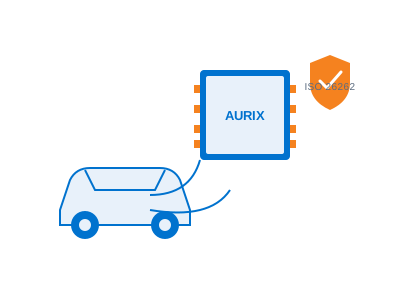
This article provides an industry analysis of how AURIX MCUs are enabling original equipment manufacturers (OEMs) and Tier-1 suppliers to achieve compliance with ISO 26262, the international standard for functional safety in road vehicles. It also examines specific application areas where AURIX has become the dominant platform of choice, and addresses supply chain considerations for engineering teams sourcing AURIX devices.
Introduction to Functional Safety in Automotive Electronics
ISO 26262 establishes a framework for managing safety in automotive electronic systems. It classifies automotive functions according to Automotive Safety Integrity Levels (ASIL), ranging from ASIL-A (lowest risk) to ASIL-D (highest risk). Functions such as electronic brake control, electric power steering, and airbag deployment must typically meet ASIL-D requirements, while less critical functions may be rated ASIL-A or ASIL-B.
Achieving and maintaining ASIL-D compliance requires careful architecture-level design decisions. Hardware redundancy, self-test mechanisms, error-correcting memory, and hardware security modules (HSMs) are features that must be present in the MCU itself. Relying on external components to add these capabilities increases board complexity, cost, and certification effort. This is precisely the challenge that Infineon designed the AURIX family to address.
The certification process for automotive safety systems also requires extensive documentation. Semiconductor suppliers must provide Functional Safety Manuals, Safety Analysis Reports, and evidence of hardware diagnostic coverage for their devices. Infineon provides these documents for all AURIX family members, significantly reducing the burden on OEMs and Tier-1 suppliers during their own ISO 26262 certification activities.
The AURIX Architecture and ISO 26262 Compliance
The AURIX TC2xx and TC3xx families are built on Infineon's proprietary TriCore architecture, a 32-bit RISC core optimized for safety, real-time control, and embedded DSP operations. What sets AURIX apart is its multi-core configuration with lockstep redundancy. In a typical ASIL-D-rated AURIX device, two TriCore cores run in lockstep mode, executing the same instructions in parallel and comparing outputs on each clock cycle. Any discrepancy between the two cores triggers an immediate safety reaction, preventing undetected hardware failures from causing incorrect system behavior.
Beyond lockstep, AURIX integrates additional safety mechanisms at the hardware level. An onboard Program Flow Monitoring unit checks that the processor is executing instructions in the correct sequence. Hardware memory protection units (MPUs) prevent software tasks from accessing memory regions they should not, reducing the risk of software faults propagating into safety-critical code. Error Detection and Correction logic protects flash and RAM against single-bit upsets, a concern in harsh automotive environments where radiation and electromagnetic interference are present.
The AURIX TC3xx family extends these capabilities with additional TriCore cores and a dedicated Hardware Security Module (HSM) that supports AES-128 and AES-256 encryption, secure boot, and authenticated firmware updates. As connected vehicles become standard, the HSM enables OEMs to implement over-the-air (OTA) software update pipelines that are both secure and verifiable.
Key Applications of AURIX in Safety-Critical Systems
AURIX MCUs have been adopted across a wide range of automotive safety applications. In electric power steering (EPS) systems, AURIX manages the torque sensor inputs and motor control algorithms that determine steering feel and stability. The dual-core lockstep architecture ensures that a hardware fault in the MCU does not cause unexpected steering commands, a scenario that could be catastrophic at highway speeds.
In battery management systems (BMS) for electric vehicles, AURIX handles cell voltage monitoring, state-of-charge estimation, and thermal management control. The strict voltage measurement accuracy and real-time processing demands of BMS applications align well with the AURIX core architecture and its rich set of ADC and communication peripherals.
Transmission control units (TCUs) use AURIX to manage gear selection logic, clutch actuation, and communication with the engine control unit (ECU) over CAN FD and FlexRay buses. AURIX's onboard bus controllers and cryptographic acceleration modules make it well suited for connected powertrain applications where OTA software updates must be securely authenticated.
ADAS domain controllers represent one of the most demanding AURIX application areas. In an ADAS domain controller, multiple AURIX TC3xx devices may work together, each processing sensor data from radar, camera, or lidar systems and sharing results over high-speed automotive Ethernet. The AURIX TC3xx's multi-core architecture allows engineers to partition ASIL-D safety functions from QM-rated comfort features on separate cores within the same device, optimizing silicon utilization.
TC264DA: A Platform for ASIL-D Design
Among the AURIX TC2xx family members, the TC264DA has emerged as a popular platform for ASIL-D-rated motor control and chassis applications. The TC264DA integrates three TriCore cores -- two running in lockstep for ASIL-D coverage and one independent core for ASIL-B tasks -- together with 4 MB of flash memory and 472 KB of SRAM. This memory configuration supports complex safety software stacks while leaving headroom for application code.
The TC264DA includes Infineon's Safety Management Unit (SMU), a dedicated hardware block that monitors the health of all on-chip subsystems and orchestrates safety reactions when faults are detected. The SMU can trigger processor resets, activate external safety relays, or initiate graceful shutdown sequences, giving system designers precise control over fault handling behavior.
For engineers designing ASIL-D systems, the TC264DA's certification evidence package simplifies the safety case development process. Infineon provides a Functional Safety Manual, a Safety Analysis Report, and AUTOSAR-compatible software drivers, all of which reduce the documentation burden on OEMs and Tier-1 suppliers working toward ISO 26262 certification.
Sourcing AURIX MCUs from Authorized Distributors
Given the safety-critical nature of AURIX applications, component authenticity and supply chain integrity are paramount. Automotive OEMs and Tier-1 suppliers require full traceability for every component in a safety-relevant system. This requirement makes the choice of distributor critical.
BeiLuo, as an authorized Infineon distributor, provides AURIX MCUs with full documentation traceability from Infineon's factory to the customer's receiving dock. BeiLuo's inventory includes the TC264DA and other AURIX TC2xx and TC3xx devices, available for both prototype quantities and production volumes.
BeiLuo's field application engineers (FAEs) have experience with AURIX-based designs and can assist customers with device selection, software stack configuration, and safety documentation requirements. For automotive engineers working on next-generation ADAS or EV powertrain systems, partnering with an authorized Infineon distributor like BeiLuo ensures that the AURIX components at the heart of their design are genuine, traceable, and supported by a technically capable supply chain partner.