The power semiconductor industry is in the midst of a generational shift. For decades, silicon transistors dominated power conversion applications, from motor drives and power supplies to automotive inverters. Today, a new class of materials -- wide bandgap (WBG) semiconductors, primarily silicon carbide (SiC) and gallium nitride (GaN) -- are challenging silicon's supremacy in high-efficiency power conversion. This article examines the market trends driving WBG adoption, reviews Infineon's strategic position in this fast-moving landscape, and explores what these changes mean for component distributors, OEMs, and system designers.
Understanding Wide Bandgap Technology
Wide bandgap semiconductors derive their name from the energy gap between the valence band and conduction band in their crystal structure. Silicon has a bandgap of approximately 1.12 electron volts (eV). Silicon carbide has a bandgap of approximately 3.26 eV, and gallium nitride has a bandgap of approximately 3.4 eV. This larger bandgap confers several fundamental material advantages over silicon.
First, WBG devices can sustain much higher electric fields than silicon before avalanche breakdown occurs. This allows WBG power transistors to be physically thinner for a given voltage rating, reducing on-resistance and switching losses. Second, WBG materials can operate at higher junction temperatures, up to 175 degrees Celsius or beyond for SiC, enabling more aggressive thermal management strategies and smaller, lighter heatsinks. Third, WBG transistors switch faster than silicon, reducing switching losses and enabling higher switching frequencies that allow smaller passive components such as inductors and capacitors in the circuit.
These properties translate into higher efficiency, smaller size, and lighter weight in power conversion systems. These are exactly the attributes that the automotive and industrial markets need as they push for greater energy density and lower total cost of ownership over the product lifetime.
Silicon Carbide Market Growth Drivers
Silicon carbide has seen explosive adoption in electric vehicle (EV) traction inverters. The EV powertrain inverter converts DC battery power into three-phase AC for the traction motor, handling voltages of 400 V to 800 V and currents of hundreds of amperes. SiC MOSFETs, with their lower switching losses and higher operating temperature capability, deliver measurable improvements in EV range, charging speed, and powertrain efficiency compared to silicon IGBTs.
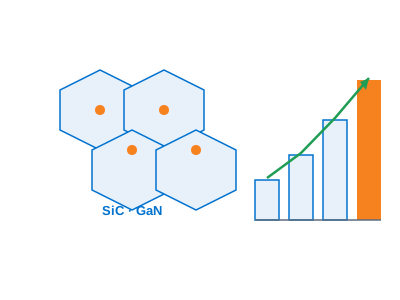
Leading EV manufacturers have publicly committed to SiC traction inverters as standard technology in new platforms. This commitment has triggered a wave of investment in SiC wafer production, epitaxial growth, and device packaging. According to market research published by Yole Group, a firm specializing in compound-semiconductor market analysis, the SiC power device market is projected to grow from approximately 2 billion USD in 2022 to over 10 billion USD by 2027, driven primarily by EV adoption in China, Europe, and North America.
Beyond EVs, SiC is gaining ground in solar inverters, industrial motor drives, and energy storage systems. In solar applications, SiC MOSFETs enable higher switching frequencies that reduce the size of transformers and filters, while their lower conduction losses improve overall system efficiency ratings. This is a critical factor in utility-scale solar installations where every percentage point of efficiency improvement has significant economic value over the system's 25-year operational life.
Industrial motor drive manufacturers are also beginning to qualify SiC-based designs. At voltages above 600 V, SiC MOSFETs offer a compelling alternative to silicon IGBTs for medium-voltage drive applications. While the device cost premium for SiC remains meaningful, the total system cost advantage from reduced cooling requirements and smaller passive components is increasingly difficult to ignore.
Gallium Nitride in Power Electronics
Gallium nitride power transistors have found their initial commercial success in lower-voltage applications, primarily in the 100 V to 650 V range. GaN high-electron-mobility transistors (HEMTs) achieve extremely fast switching speeds, enabling power supply switching frequencies in the megahertz range. This allows power supply designers to drastically reduce the size of magnetic and capacitive components, enabling the compact, lightweight USB Power Delivery adapters and server power supplies that consumers and data center operators increasingly demand.
In the industrial market, GaN is finding applications in wireless power transfer systems, lidar power supplies for autonomous vehicles, and high-density DC-DC converters for telecom and data center use. As GaN device voltage ratings extend toward 900 V and 1200 V, the technology may also challenge SiC in some medium-voltage motor drive applications over the coming years.
One challenge for GaN adoption has been gate drive complexity. GaN transistors require precise gate voltage control to prevent damage. Infineon has addressed this through its CoolGaN product line, which uses a cascode configuration pairing a GaN HEMT with a silicon transistor to provide a normally-off device with robust gate-drive compatibility. This approach simplifies circuit design and reduces the risk of gate overvoltage failures, making CoolGaN accessible to engineers with a silicon design background.
Infineon's Position in the WBG Market
Infineon Technologies has invested heavily to establish a leading position in both SiC and GaN. In the SiC space, Infineon's CoolSiC MOSFET family offers devices rated from 650 V to 1700 V, covering the full range of automotive and industrial voltage requirements. Infineon has been expanding its SiC production capacity at its Villach, Austria facility, one of Europe's largest dedicated power semiconductor fabs. The company has also secured long-term supply agreements with SiC wafer suppliers to ensure a stable raw material supply chain.
In GaN, Infineon's CoolGaN family addresses the growing demand for high-efficiency, high-density power conversion in consumer and industrial applications. Infineon offers both standalone CoolGaN transistors and integrated solutions where the gate driver IC is co-packaged with the GaN device, further simplifying the design process for engineers who are new to GaN technology.
Infineon's dual investment in SiC and GaN reflects a realistic assessment of the market. Neither technology will eliminate the other in the near term. SiC is better suited to high-voltage, high-current applications where its superior avalanche capability and high-temperature performance provide clear advantages. GaN excels in high-frequency, medium-voltage applications where switching speed is the primary driver. By offering both, Infineon and its distributors can address the complete range of WBG application requirements from a single product family relationship.
Implications for Distributors and OEMs
For OEMs designing new power conversion systems, the expanding WBG product portfolio offers significant performance opportunities but also introduces new design challenges. Gate drive requirements, thermal management strategies, and layout practices for WBG devices differ meaningfully from silicon designs. Engineers accustomed to silicon IGBTs or MOSFETs must invest time in learning new design rules, and the consequences of layout errors are more severe at the higher switching speeds that WBG devices enable.
This is where working with an authorized Infineon distributor like BeiLuo becomes particularly valuable. BeiLuo's field application engineers (FAEs) have hands-on experience with Infineon's CoolSiC and CoolGaN product families, and can assist customers with device selection, gate driver design, PCB layout review, and thermal analysis. BeiLuo maintains stock of key CoolSiC and CoolGaN devices, providing fast access to samples for evaluation and production quantities for volume customers.
As the WBG market matures, supply chain reliability will become an increasingly important concern. Early-generation WBG devices were often available only through direct Infineon channels or a small number of global distributors. By building relationships with authorized regional distributors like BeiLuo, OEMs can secure more resilient supply chains and benefit from localized technical and logistics support.
The wide bandgap semiconductor revolution is well underway. For engineering teams and procurement organizations planning their next-generation power conversion designs, now is the time to engage with WBG technology and to partner with distributors who have both the technical depth and the inventory commitment to support that journey from prototype to production.