
Home Appliance Motor Drive Solution with Infineon OptiMOS MOSFET and XMC MCU
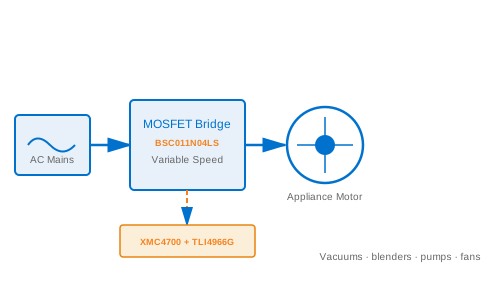
Home ApplianceA compact BLDC motor drive solution for home appliances built around Infineon's low-voltage OptiMOS MOSFET and XMC motor-control MCU, sourced from BeiLuo. Covers low-voltage inverter bridge design, commutation control, and acoustic noise reduction for vacuums, blenders, pumps, and fans.
Key Advantages
- BSC011N04LS OptiMOS 5 MOSFET's 1.1 milliohm RDSon at 40 V keeps conduction losses under 0.3 W per device even at 20 kHz+ switching frequencies chosen to avoid audible motor noise
- TDSON-8 dual-MOSFET package lets one full half-bridge leg fit in a footprint smaller than a coin, critical for compact vacuum and blender control-board enclosures
- XMC4700's CCU8 PWM peripheral generates hardware dead-time-managed six-step or sensored-FOC commutation without added shoot-through risk
- BeiLuo in-stock supply of BSC011N04LS, XMC4700-F100K2048, and TLI4966G with FAE-supported reference firmware shortens appliance design cycles ahead of seasonal product launches
Overview of Home Appliance Motor Drive Design
Modern home appliances -- robot vacuums, cordless stick vacuums, kitchen blenders and food processors, exhaust and circulation fans, and dishwasher circulation pumps -- have shifted from brushed DC motors and simple AC induction designs to brushless DC (BLDC) motors driven by dedicated power electronics. The reasons are consistent across categories: BLDC motors run quieter, last longer without brush wear, and respond to variable-speed control that brushed motors and single-speed AC motors cannot match. Appliance manufacturers competing on energy-efficiency labels and noise ratings need an inverter stage that is efficient at low voltage, compact enough for consumer product enclosures, and inexpensive enough to hit aggressive appliance bill-of-materials targets. Infineon's OptiMOS 5 low-voltage MOSFET family, paired with an XMC4700 motor control MCU and a TLI4966G Hall-effect sensor, addresses exactly this combination of requirements.
Low-Voltage MOSFET Bridge with BSC011N04LS
Most home appliance BLDC motors operate from a rectified single-phase supply after a step-down transformer, or directly from a 24 V to 48 V battery pack in cordless designs. At these voltages, MOSFETs -- not IGBTs -- are the correct switching device, because MOSFET conduction losses scale with RDSon rather than a fixed VCEsat, and RDSon falls sharply as voltage rating decreases. The BSC011N04LS OptiMOS 5 MOSFET, rated 40 V with an RDSon of just 1.1 milliohm, is well matched to this class of drive. In a three-phase full-bridge configuration (six MOSFETs, two per phase leg), conduction losses at a typical 8 A RMS phase current are under 0.3 W per device, which keeps the entire power stage well within the thermal budget of a compact plastic appliance housing with no heat sink beyond a modest copper pour on the PCB.
The TDSON-8 package used by the BSC011N04LS is a dual-MOSFET footprint, so a single package can implement one full half-bridge leg -- three packages complete a three-phase inverter in a PCB area smaller than a coin. This matters directly for appliance manufacturers, where control-board real estate inside a vacuum handle or blender base is often the tightest constraint in the entire product.
Motor Control with the XMC4700 MCU
The XMC4700-F100K2048 brings an ARM Cortex-M4F core running at 144 MHz with a dedicated CCU8 PWM peripheral built for motor control, generating the six complementary PWM signals needed to drive a three-phase bridge with hardware dead-time insertion -- eliminating the need for software-managed dead time and the shoot-through risk that comes with it. The MCU's floating-point unit accelerates the Clarke and Park transforms used in field-oriented control (FOC), enabling smooth, low-vibration torque control even at the low electrical speeds where BLDC commutation is traditionally roughest sounding. For appliance designs that use simpler six-step (trapezoidal) commutation instead of full FOC, the same CCU8 peripheral supports Hall-sensor-based commutation with minimal firmware overhead, which is common in cost-sensitive fan and pump applications where a few percent of extra motor efficiency does not justify the added firmware complexity of sensorless FOC.
Because the XMC4700 is a general-purpose industrial MCU rather than an appliance-specific ASSP, the same firmware architecture used for one appliance product line -- say, a stick vacuum -- can be substantially reused for a related product such as a robot vacuum or a cordless blender, reducing the software qualification burden across an appliance manufacturer's product portfolio.
Commutation Feedback with TLI4966G
The TLI4966G dual-channel Hall-effect speed sensor provides the rotor position feedback needed for reliable commutation, whether the firmware implements six-step trapezoidal control or full sensored FOC. Its differential dual-channel output rejects common-mode magnetic noise from the motor's own stator field, which is particularly important in the compact motor designs used in handheld appliances where the sensor sits only a few millimeters from the stator windings. The digital output interfaces directly to the XMC4700's timer capture inputs, requiring no analog signal conditioning and keeping the appliance's total bill of materials lean.
Noise, Efficiency, and Compliance Considerations
Appliance BLDC drives face acoustic noise constraints that industrial drives generally do not: a vacuum cleaner or blender operates in a living space a few feet from the user, so audible motor whine from PWM switching frequencies in the human hearing range is a real product-quality issue. Running the BSC011N04LS bridge at a 20 kHz or higher switching frequency, above the top of typical human hearing sensitivity, avoids audible switching tones while the MOSFET's low gate charge keeps switching losses manageable even at this elevated frequency -- a tradeoff that would be far less favorable with a higher-RDSon or higher-voltage device. On the efficiency side, national and regional appliance energy-labeling programs increasingly test standby and variable-load efficiency, not just peak-power efficiency; the low conduction and switching losses of the OptiMOS 5 bridge help appliance designs clear these thresholds with margin rather than by a narrow pass.
PCB Layout and Thermal Guidance
Even without a dedicated heat sink, appliance motor-drive PCBs benefit from a solid ground-plane pour beneath the MOSFET bridge and short, wide gate-drive traces to minimize parasitic inductance, which both improves switching behavior and reduces EMI radiated from the compact enclosure. BeiLuo's FAE team routinely reviews appliance power-stage layouts for our customers, checking gate-loop area, current-sense shunt placement, and Hall-sensor magnet-to-sensor air gap before the first prototype spin, which for appliance customers -- who often work on tight seasonal product launch schedules -- avoids a second layout iteration that can cost several weeks.
Application Scenarios
This combination of BSC011N04LS MOSFETs, XMC4700 MCU, and TLI4966G Hall sensor supports BLDC drives across a wide range of home appliance categories: cordless stick vacuums and robot vacuum cleaners running from 21.6 V to 25.2 V battery packs, corded upright vacuums and kitchen blenders operating from rectified mains supplies, dishwasher and washing machine circulation pumps requiring variable flow control, and exhaust or HVAC circulation fans needing quiet, efficient variable-speed operation. BeiLuo maintains stock of all three components and provides FAE-supported reference firmware for both six-step and sensored-FOC commutation modes, helping appliance OEMs and their contract manufacturers move from concept to certified production samples in a single design cycle.
Bill of Materials
| Part No. | Description | Qty |
|---|---|---|
| BSC011N04LS | 40 V OptiMOS 5 dual MOSFET in TDSON-8 -- three packages form the three-phase low-voltage inverter bridge | 3 |
| XMC4700-F100K2048 | 144 MHz ARM Cortex-M4F MCU with CCU8 PWM peripheral -- generates six-step or sensored-FOC commutation signals | 1 |
| TLI4966G | Dual-channel differential Hall-effect speed sensor -- rotor commutation feedback for the motor control loop | 1 |
Ready to Build This Solution?
Contact BeiLuo for component sourcing, FAE support, and reference designs.
Get BOM Quote